
Discover the
ScienceFacts©
Discover the
world of sonares
ScienceFacts©
Where scientific facts become tangible and new findings change our lives.
Register now in advance and we will notify you as soon as the ScienceHub is online.
Register now
Our mission:
We make science tangible for everyone
There are numerous studies on almost every important topic worldwide - filled with scientific findings. But what do those findings mean for each and every one of us? Could they change people's lives if they were better known? At sonares, we believe: they most definitely can! That's why we made it our mission to develop completely new tools that make science tangible for everyone: the sonares ScienceFacts.
To develop ScienceFacts and - in cooperation with universities, scientific institutes and other institutions - our scientific staff creates computational models, which apply results of selected studies to individuals. In doing so, they only use peer-reviewed studies that have been written by independent and credible sources and published publicly in accordance with scientific standards. Science at its best!

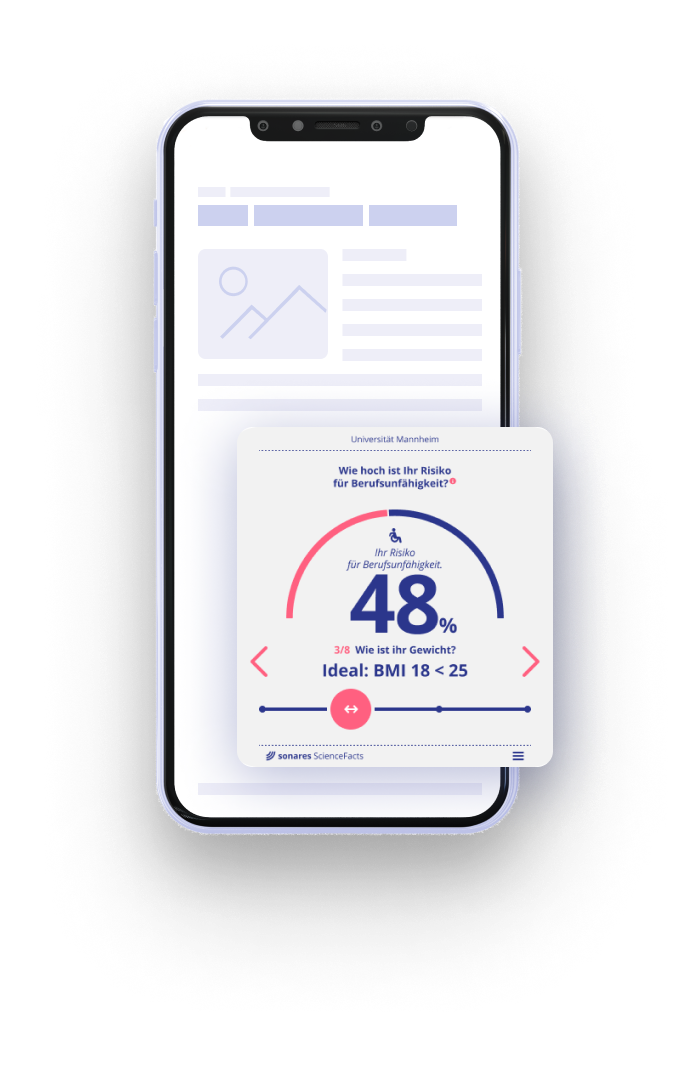
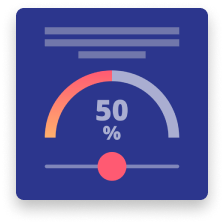
ScienceFacts make content more relevant
ScienceFacts is a new generation of interactive content that enables website operators to enhance their content with scientific facts. Thanks to state-of-the-art web technology, their integration is quick and easy and their operation is permanently reliable and performant. ScienceFacts can be used on any type of website - from private web presences to high-reach news portals.
ScienceFacts make content more relevant
Our ScienceFacts form a new generation of interactive content that enables website operators to enhance their content with scientific facts. Thanks to state-of-the-art web technology, their integration is quick and easy and their operation is continuously reliable and performant. ScienceFacts can be used on any type of website - from private web presences to high-reach news portals.
Scientific findings
for each and everyone:

Minimum loading times
When integrating ScienceFacts, there are virtually no relevant loading times. Users - and search engines - like that.

More interesting websites
Websites are more interesting for users if they have individually relevant, scientific content.

High engagement rate
Interactive, scientific content that promises individual insights gets significantly more clicks.

Improved average time spend
If users are (inter)actively engaged with the content, they automatically stay longer on the website.

Better SEO Ranking
The longer the time spent on a page, the higher search engines rate its relevance - which helps with SEO ranking.

User Analytics
With assistance of user analytics, groups of users can be statistically evaluated and page content customized for them.
Entdecken Sie alle Vorteile die Sie durch die Verwendung von ScienceFacts erhalten

More interesting websites
ScienceFacts add scientific content to websites, making them even more interesting for the user.

Personal relevance
Users can learn through ScienceFacts how scientific studies and findings can have an effect on themselves and their lives.

Knowledge can change lives
Scientific findings show users ways to help optimise their behaviour and lives.

Resilient sources
All computational models in our ScienceFacts are based on verified scientific studies from independent sources.

100% anonymity
Personal data is never saved at sonares and will never be passed on to third parties without your explicit approval or legal requirement.

Interaction with fun
ScienceFacts react to user-inputs without delay; their operation is simple and fun.
Erfahren Sie alles zu den einzelnen ScienceFacts. In unserem Journal finden Sie alle Artikel und könne sie live testen.

Bringing science to life
Scientists can make their study results tangible for many people by means of self-developed computational models.
Personal relevance
ScienceFacts make the results of scientific studies relevant on an individual level.

Change something
ScienceFacts can use scientific findings to help people change their lives for the better.

Find public
Universities can make their offerings and work accessible to a broad public via ScienceFacts.

Own studies
With the assistance of our user statistics for ScienceFacts, you can quickly and easily realise your own studies and thus gain new insights.

Simply join in
Scientists who would like to develop ScienceFacts themselves are cordially invited to join our scientific community!
Discover all the benefits you get by using ScienceFacts.
Find out how ScienceFacts can change your life
ScienceFacts create an actual connection from abstract numbers to one’s everyday life. You want to try it out? Here's a small selection of our latest ScienceFacts. Get new insights tailored to you!
Register now in advance and we will notify you as soon as the ScienceHub is online.
Register now
Topic: Health
Life expectancy
How old will you live? Calculate your individual life expectancy using more than 16 factors. By making lifestyle changes, you can improve your own life expectancy by up to 40 years.
© Model created by: Dr. Hannes Guhl
Topic: Society
Celebrity-Check
This is your life expectancy compared to well-known celebrities! Want to know what you can do to get even older? This ScienceFact shows you!
© Model created by: Dr. Hannes Guhl
Topic: Work
Occupational disability
The risk of becoming unable to work depends on demographic factors, but also on the occupation and personal lifestyle. Learn about your risk of becoming unable to work.
© Model created by: Martina Backes
Topic: Health
Life expectancy
How long will you live? Calculate your individual life expectancy using more than 16 factors. By making lifestyle changes, you can improve your own life expectancy by up to 40 years.
© Model created by: Dr. Hannes Guhl
Topic: Society
Celebrity-Check
This is your life expectancy compared to well-known celebrities! Want to know what you can do to get even older? This ScienceFact shows you!
© Model created by: Dr. Hannes Guhl
Topic: Work
Occupational disability
The risk of becoming unable to work depends on demographic factors, but also on the occupation and personal lifestyle. Learn about your risk of becoming unable to work.
© Model created by: Martina Backes
Wir danken für die wissenschaftliche Unterstützung
We would like to thank our numerous partners in the scientific community who support us actively, passively and through their research work in the creation of ScienceFacts and help us to make science accessible to everyone.
Do you have your own idea for a ScienceFact that the world desperately needs?
We look forward to your ideas - just contact us!
E-Mail: info@sonares.org
9
running ScienceFacts
137
Inclusions on web pages
319683
Engagements
6393667
individual calculations
What matters to us at sonares
As a scientific service, we are committed to high standards. We have fixed, immutable principles that we always observe in our work:

Compliance
with scientific
principles
Here at sonares, we work according to the principles of scientific work: Our services are always comprehensible, methodically correct, complete, precise, independent and truthful. You should always be able to rely on the results of our ScienceFacts.

User experience
with fun and important
insights
We offer services at sonares, that highlight important topics. At the same time, it is important to us that the operation is easy and fun. That's why we take great care to ensure that entertainment is not neglected and that we make you want to stay on the site for a long time.

Guaranteed
protection of data
and privacy
The privacy of our users is of highest priority at sonares. That's why we collect the data entered into our services anonymously. And it is only stored on the user's device - not on sonares’ servers. We never share personal data with others without permission.
Are you a content creator, editor or publisher?
You would like to integrate ScienceFacts on your website? Or do you have ideas for topics that are of interest to your users? Then simply get in touch with us! We will show you how to make your website even more interesting!
Are you a scientist or a number cruncher?
Become part of our scientific community! We have way more projects than people to implement them. Permanent, freelance or part-time? With us, everything is possible!
Frequently asked questions
Can ScienceFacts be embedded on any page?
ScienceFacts can be integrated in any website that meets our requirements. Sites with illegal, violence glorifying, pornographic, defamatory or discriminatory content of any kind, are excluded. We reserve the right to refuse or disable integrations on pages that violate our principles.
Are ScienceFacts and the ScienceHub relevant to everyone?
Absolutely. Since scientific data and scientific findings affect the lives of every single person in the world, they can also help to change or improve it.
Is user data protected from misuse?
Protecting the privacy of our users is our highest priority. Therefore, user entries are processed anonymously only. Users can delete the data entered on their end user device at any time. No personal data is stored on sonares' servers.
Does sonares comply with GDPR (DSGVO) guidelines?
Of course. We have voluntarily committed ourselves to comply with all transparency and user consent requirements set by the GDPR. We believe that data privacy and data usage should solely be in the interest of the user. That is why we are a proud member of IAB and support the current TCF 2.0 framework.
How are user inputs used scientifically?
The use of ScienceFacts and the statistical analysis thereof serve our employees, scientists and partners to conduct their own studies and to gain new insights through them. For this purpose, we provide our partners with statistical, anonymous usage data of our ScienceFacts, which they in turn can use to further develop their statistical models and theories or improve their content offerings.
Where do I see the performance of ScienceFacts?
Conveniently in the ScienceHub. Here you can find out how the ScienceFacts you use - and all others - perform and compare them with each other if you wish. In addition, you will find extensive options for statistical analysis of usage in the ScienceHub.
Are there technical requirements for the integration?
Technically, ScienceFacts can be used on any public page on the internet. They are integrated by means of a so-called iFrame and are loaded securely and almost instantaneously into the page. They can easily be combined with any CMS, such as WordPress.

 English
  German
  Spanish
  French
  Polish